Bespoke staircase design is without a doubt, subjective. Here we assess if there can be a defined architectural process which assures the most beautiful and spectacular result every time. No matter the prestige, location or style of a property, if a staircase is to fit perfectly within its home and surrounding space, there are common architectural design principles to consider. This year is a time of reflection for world renowned staircase specialist, Bisca. As the business celebrates 30 years in the staircase industry, their diverse range of projects from all over the world, offers valuable insight.
In two of the firm’s most recent projects, we review their input as staircase design-makers; evaluating how they ensure the true potential of a staircase is reached…
From Malton to Montana, Two Contrasting Architectural Staircase Designs
Richard McLane, founder and design director at Bisca, comments: “These two projects have been contrasting in many respects, yet identical in others. While a staircase project’s success relies on the early stages of planning, including the property’s unique architectural features; building specification; structural boundaries; and internal aesthetics – what is often overlooked is a client’s emotional expectations.”
Bisca’s portfolio pushes the limitations of bespoke staircase engineering to new heights, with many of their projects appearing to be structurally impossible at first sight. Seeking to achieve a flawless transition between different staircase materials, while creating a tactile connection that cannot be replicated elsewhere in a home; these are not architectural outcomes that are achieved by chance.
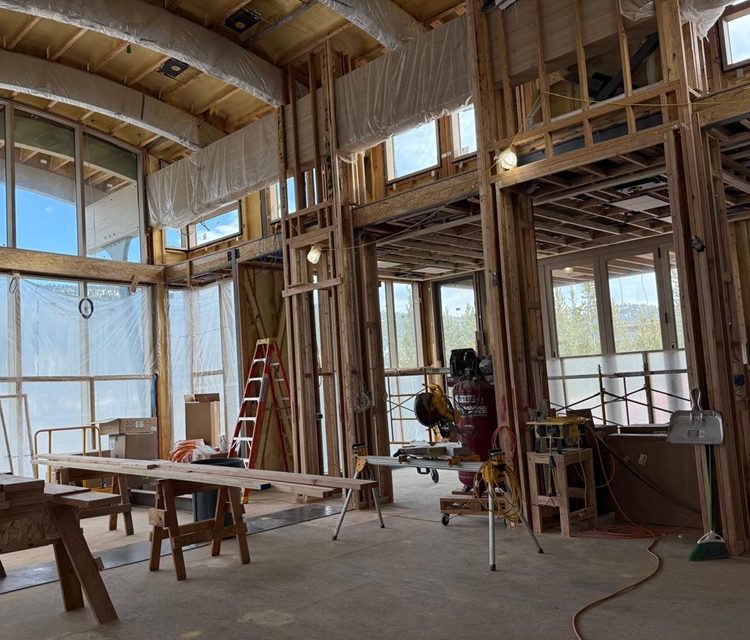
Ski Resort, Montana (USA) – Private Mansion Staircase
Client brief: An open brief for Bisca to work their magic, creating a unique staircase with a strong sculptural presence
Layout: Bespoke two flight helical staircase with open rise treads
Direction: Ground floor descending to lower ground, then to an extensive basement
Materials: Oak, glass, leather, steel, liquid metal finish, integrated lighting
Limitations: Pre-defined/inflexible space and position of supporting beams
Technical: The staircase is supported through its base and fixed to landing edges at each level. Large maximum tread width of 1.8m, designed with a floating appearance and no visible fixings
Logistics: Transportation 4,000+ miles, including two core structural sections, with multiple landing sections, plus individual staircase features
Status: Design completed. Currently in manufacture in Bisca’s specialist workshop premises. Installation planned 2026.
Key Architectural Considerations:
A newly built ski residence in Montana, situated on a mountain side; its staircase design comprising a two flight helical structure connecting three floors. Descending from the upper living space next to the main front door, the staircase transitions to a lower floor of bedrooms and further, to a ski boot room with impressive panoramic views and more living accommodation.
The original building design compromised the staircase’s sculptural potential. Bisca worked closely with the project engineer, architect and contracting team in America to meet the brief – adjusting loading beams to optimise the architectural staircase layout, comfort, rise and how its form flowed within the space.
To accommodate a unique floating appearance and assure structural integrity, each staircase tread has a steel core wrapped in engineered timber, meeting both technical and aesthetic requirements. A wide range of materials are connected sensitively, to create a seamless and breathtaking finish.
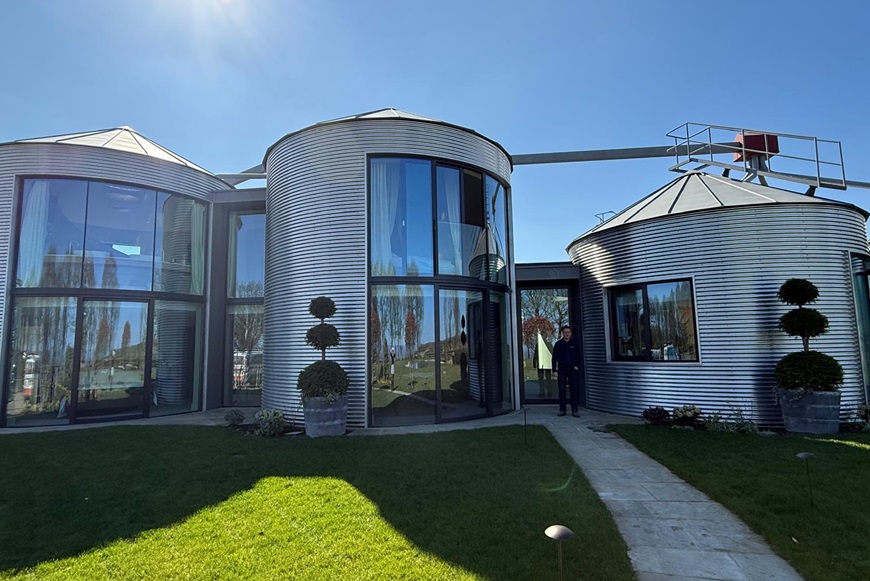
Grain Silos, Malton (UK) – Agricultural Renovation Staircase
Client brief: To create a feature staircase which resembles a bolt of lightning dropping down through the glass roof above
Layout: Single flight helical staircase with sweeping cut-string treads
Direction: Ground floor upwards, to meet first floor landing
Materials: Oak, steel, curved glass, waxed metal finish
Limitations: Replicating the same liquid finish on a range of different materials
Technical: Structurally challenging, a need to minimise deflection due to its unique design, with large feature wall to the core, installed in one piece to create a solid yet delicate structure
Logistics: Transportation 10 miles to the property, the main body as three separate parts. The central steel wall in one continuous piece using bespoke fabricated trolleys
Status: Staircase designed, manufactured and installed by Bisca
Key Architectural Considerations:
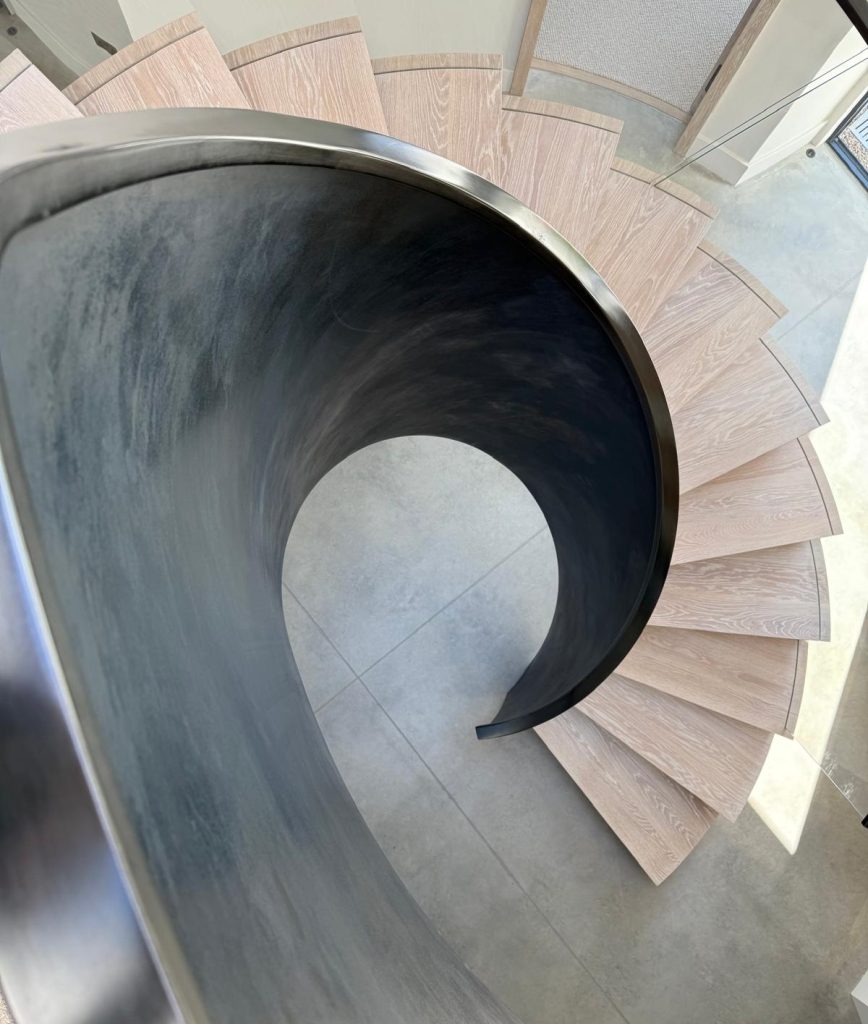
In contrast to Montana, the staircase for an agricultural conversion in Malton is positioned centrally within a cluster of interconnected grain silos. A unique helical layout rises from the ground floor to the first floor and has been designed to represent a bolt of lightning dropping out of the sky.
In this case the building’s steel frame was specified to architects in order to accommodate the actual staircase loadings, making our client’s chosen design a reality from the start. Precision engineering allows for the staircase to rest on a slim and elegant point of contact as it meets the ground floor. This brought structural challenges where steel works and plating have been concealed to reduce deflection.
The unique metallic finish applied to the staircase’s central steel wall is matched on the slim and elegant handrail. This has been achieved using bonded polymers; thereafter bespoke staircase lighting was integrated and concealed within the inner handrail to highlight its form and the patina of the feature wall.
Taking an Architectural Staircase Design from Concept to Reality
Richard continues: “It’s essential that technical aspects of staircase engineering are not allowed to stifle the creative element of the design process.
“Both must work hand in hand, where buildability is fully integrated to the concept design stage, assuring a client’s practical and personal aspirations are transformed into a reality.”
To plan for all aspects of a bespoke staircase design, Bisca undertakes one, if not two specialist staircase surveys early in the process. Through collaborating closely with project stakeholders such as architects, interior designers and contractors, no stone is left unturned and a clear and collective vision is formulated at the outset.
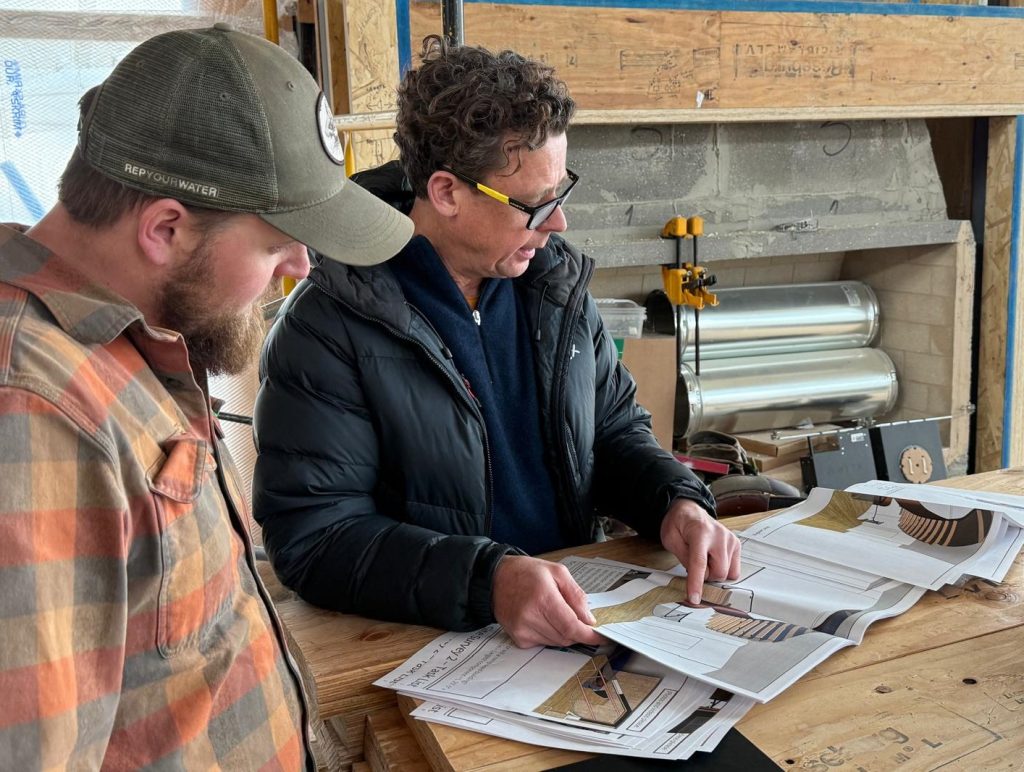
Richard concludes: “For me, this is one of the most exciting stages of what we do; it sparks the creativity required to develop a unique staircase which will take your breath away – striking an emotional connection with all that cross its path. As staircase specialists, when we see a concept finally come into its true form, this is always a deeply rewarding experience.”
To find out more about Bisca’s experience of working with architects, visit their website here.