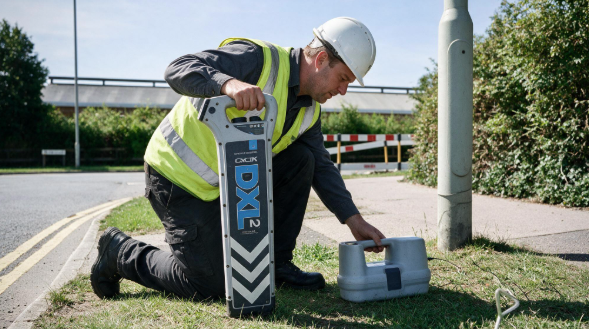
There is a Genny and CAT in almost every site van in the country. The equipment is familiar, standard and trusted. That is exactly why underground strikes keep happening: the problem was never the kit; it is the technique, and the technique is rarely taught properly.
Ask most operatives about a Cable Avoidance Tool, and they will tell you they use one every day. That familiarity is the trap. The CAT has become so routine that the way it is handled goes unexamined, and the unexamined version is usually the wrong one. A quick sweep in a passive mode, a clear reading, and the dig begins. It feels thorough. On plenty of sites it is not.
The gap between using the kit and using it well is where strikes live. Two crews can carry identical equipment and follow what looks like the same routine, yet find very different things in the ground, because one is confirming what is there and the other is trusting what happens to show up. From the outside, the two are indistinguishable. The difference only appears when a service that never registered turns out to be exactly where someone is about to dig.
Closing that gap is the entire point of hands-on Genny and CAT training. Sygma Solutions, the Wigan firm that is the UK’s only independent specialist in underground utility location and avoidance, has spent over twenty years on the technique rather than the tool.
Founder Peter Ashcroft comments: “Everyone has the kit, and everyone thinks they can use it. Watch a site for an hour, and you will see the same thing again and again: the CAT swept in a passive mode, a quiet reading taken as a clear one, and the Genny still clipped to the van. That is where strikes come from, and it is a habit, not a shortage of equipment.”
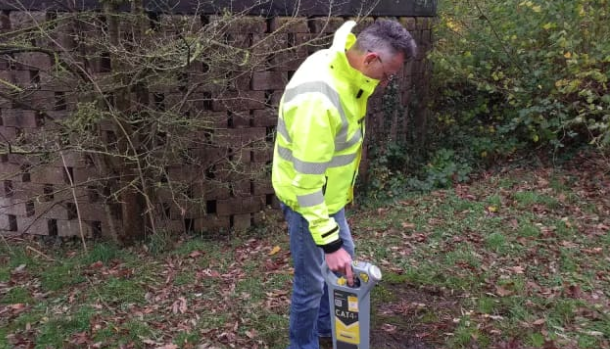
The two devices are meant to work as a pair. The CAT detects signals given off by buried conductors. The Genny applies a known signal to a specific line so the CAT can trace it deliberately. Left in its passive settings, the CAT only hears what is already broadcasting, and a great deal underground is not: an unenergised cable, a circuit switched off that day, a balanced load that cancels its own field. The Genny is what turns a guess into a trace, and it is the part most crews skip.
What ‘used wrong’ actually looks like
Used wrong does not mean careless. It usually means quick, confident and incomplete. The operative sweeps, gets nothing alarming, and reads that silence as an all-clear. In a passive mode, silence means only that nothing happened to be radiating a detectable signal at that moment. It is not the same as an empty trench, and the whole risk sits in the gap between the two.
Genny first
Sygma’s fix is a reordering of the routine it calls Genny-first. Instead of sweeping with the CAT and reaching for the Genny only when something looks odd, the operative connects the Genny at the start, applies a signal to the services they expect, and works outward from certainty. Sygma’s clients report the change after training: Genny use on live sites, typically below 30% beforehand, rising to between 70 and 80%, against a target of better than 60% on every survey. Crews from Severn Trent Water and Wales & West Utilities are among those Sygma has trained.
A trained habit, not a newer tool
It is tempting to treat strikes as an equipment problem and buy the latest locator. The better return is on the operator. The kit in the van is already good enough to find almost everything down there. HSG47 and the CDM Regulations 2015 both require services to be located before breaking ground, and meeting that comes down to how the tool is used, not how new it is. The Genny and CAT in the back of the van is not the weak point. The habit it is used with is, and that is the part worth fixing.