This project was designed and delivered by Delta’s Technical Team in collaboration with Shield Waterproofing and Preservation, a Delta Registered Installer. The objective was to successfully deliver innovative flood resilience (‘PFR’) measures that would not only meet, but exceed recognised standards and codes of practice.
The privately owned detached house was built in 2007. The property flooded in 2023 and again in 2024 after poorly designed, insurance-funded retrofit works failed. These repeat incidents caused significant stress for the homeowner and damaged their trust in construction professionals and contractors.
Property Flood Resilience (PFR) strategies include measures that reduce flood damage and enable a flooded building to be recovered and reoccupied more quickly. These measures are typically grouped into resistance measures, which limit the amount of water entering a building; resilience measures, which reduce damage to the building fabric; and recoverability measures, which support faster, safe reoccupation. An effective PFR strategy may combine all three approaches to prevent water entry or limit the amount of floodwater that is able to enter the building.

PFR products can be either permanent or temporary. Permanent products are installed in-situ and remain ready to protect a building at all times, with no action needed when flooding occurs. Temporary products are stored away and deployed only when a flood is expected.
The Property Flood Resilience (PFR) design and installation featured here followed key principles of flood resistance, resilience, and recoverability, in line with best-practice guidance including BS 85500:2025 Flood resilient construction – improving the flood performance of buildings, CIRIA C790 (2020): Code of practice for property flood resilience, and the PCA Code of practice for the recovery of flood damaged buildings (2013).
Methodology
Following the six stages/standards of PFR:
- Hazard Assessment
- Property Survey
- Options for Development and Design
- Construction
- Commissioning and Handover
- Operation and Maintenance
All potential flood sources must be identified and assessed. At this property, the key sources were surface water, infrastructure failure, overland flow, and groundwater rising beneath the house. The homeowner’s experience was also considered. Together, these inputs informed a comprehensive risk assessment based on Environment Agency flood maps, geotechnical reports, drainage surveys, and utility layouts, using the widely recognised source–pathway–receptor methodology.
The second stage involved a comprehensive physical survey of the property, including its construction materials and details, supported by data from the structural engineer and coordinated by Robinson & Hall, the client’s representative.
The third stage used codes of practice and British Standards as a framework for developing options and PFR design proposals. It also involved meetings with the client, his representative, the structural engineer, the main contractor, and related trades such as M&E to ensure an integrated solution could be delivered within budget and project constraints.
The fourth stage involved detailed discussions with the client, main contractor, and design team on the key principles of flood resistance, resilience, and recoverability, including how water exclusion and controlled water entry strategies would work together. These discussions were essential to set realistic expectations for PFR performance and to agree the balance between cost, benefit, and risk.

The fifth stage involved coordinating all trades and stakeholders to develop an installation programme that clearly defined responsibilities and sequencing, ensuring the works could be delivered on time and within budget.
This flood resilience project, and the PFR solutions designed and installed, are entirely original and innovative.
Using our extensive knowledge in structural waterproofing and risk assessment for below-ground structures, Delta Membranes worked with the design and installation teams to apply expertise in design standards, forms of waterproofing, product application methods, water exclusion and water management, behaviours of diverse building materials when subjected to water ingress, and residual contamination risk to meet the flood resilience needs of an above-ground building. This approach combined creative thinking with technical rigour to ensure compliance with CIRIA C790 and BS 85500:2022.
As described, the core design rationale combined water exclusion measures to keep the building dry during shallow, short-duration floods with water entry measures and the potential consequences during deeper, longer-duration floods.
The water exclusion measures broadly comprised:
- Pre-applied fully bonded Type A waterproofing membrane beneath new concrete floor slabs.
- Type A crystalline slurries to internal faces of all internal and external walls.
- Curved fillets of repair mortar at all structural junctures.
- Sealing around all service penetrations through the structure, such as pipes, cables, drains etc.
- Closing off all wall cavities and thresholds at door reveals and other locations of structural discontinuity.
- Use of sealants, resins and other products to close off any other potential pathways.
- None return valves (NRVs) where appropriate.
The water entry measures broadly comprised:
- Design and installation of an internal water management and pumping system, based upon a typical Type C cavity drainage system that one would find in a basement.
- Use of resilient floor insulation bonded down to the new floor slabs, and other materials which are also “recoverable” in that they do not change form or properties, or support bacterial growth when immersed in flood water, and would therefore not need to be stripped out.
- Use of hydrophobic additives to cement screeds, for example, to ensure they would not break down when immersed.
- Use of ‘sacrificial’ materials – materials which would need to be removed in the event of a flood, for example, to access hidden voids for cleaning and sanitisation behind, but which can be quickly and easily replaced post-flood.
- Elimination of hidden voids which could otherwise harbour trapped contaminated flood water and pose a health risk.
- Enhancing the access and serviceability of voids which could not be eliminated (eg. increased frequency of inspection ports in perimeter drainage channels).
Installation
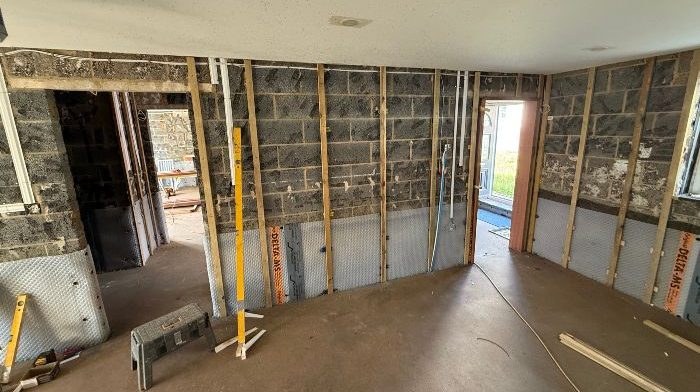
All existing/flood-damaged finishes were removed to reveal the underlying structure and allow installation.
A new ground-bearing reinforced concrete slab was designed by the structural engineer. This included Delta DualProof, a fully and permanently bonded, Pre-Applied, Type A waterproofing membrane, beneath it. Delta DualProof is a continuous pre-applied fully bonded barrier protection waterproofing membrane system which is installed on blinded hardcore prior to steel reinforcement being set out and the new concrete being poured. It’s tough and unique profile features an integrated layer of fleece on the upper face.

Delta DualProof keys with the new concrete to form an inseparable bond with such that the DualProof membrane and structure become fully integrated. This means that water ingress through any minor and un-noticed damage or defects typically caused by general building site conditions remains isolated to that specific area instead of being able to track between membrane and structure, so dramatically reducing risk of any water getting through.
The perimeter Delta Drainage Channel network was recessed within 50mm deep 100mm wide channel chases formed within the Delta Glass insulation zone, following all wall/floor juncture construction joints, so as to protect the full perimeter of the building, and to accept and drain away any flood water at the most vulnerable points of potential ingress.
External ground levels slope down towards the house, increasing the force of flow and exposing the front elevation to the greatest surface water flooding. A Delta dual packaged pumping station was installed internally near the front door to help manage this risk.
Delta Water Based Epoxy Resin offers waterproofing and protection for sand & cement screeds, mortar beds, concrete or masonry. It applies like paint, works in damp conditions, and dries to a tough, non-toxic, easy-to-clean surface.
Delta MS 500 is a robust Type C cavity drainage membrane protection system designed for demanding conditions. It combines strength, durability, functionality, and ease of installation, making it well suited to applications where structural integrity is critical.
A Type C ‘drained protection’ cavity drainage system can be a practical solution for both new-build and refurbishment projects. It consists of two main elements: internal cavity drainage membrane linings applied to the internal faces of the structure which act as a drainage space and a vapour barrier to accept and de-pressurize water ingress from outside the structure, and a maintainable internal basement drainage and pumping system, which acts to collect and control water from behind the cavity drainage membranes and pump it out to higher external surface water drainage or above flood design level, via an air gap.
BS 8102:2022 (Protection of Below Ground Structures Against Water Ingress – Code of Practice) defines Type C waterproofing as a protection system that manages water penetrating the outer shell of a building by collecting it in a cavity between the external wall and an internal lining or wall.
The Type C System forms a flexible dimpled inner membrane lining to the walls and floor which acts as physical barrier to capillary dampness and salt contamination, and also enables seepage to be collected and managed to a packaged pump station.
To enhance flood resilient performance, Delta has tailored the Type C system in such a way that it will also accept water from upon the internal finishes on the internal or ‘dry’ side of the membranes. In accordance with the water entry strategy, this acts to minimise internal flood levels and passively drains any flood water attempting to rise above floor level to a packaged pump system to be pumped out to above external flood level, also simplifying de-contamination and recovery post-flood.
Related Delta Products
- Delta MS 500
- Delta Plugs
- Delta Water Based Epoxy
- Delta DualProof
- Delta Perimeter Drainage Channel
- Delta Dual V6
- Koster KB Flex 200
- Koster KBE Liquid Film
- Koster NB1 Grey
- Koster Repair Mortar Plus
- Koster MS Joint Sealant
- Koster Mortar Tight Cement Additive
- Delta Glass Floor Insulation
- PC56 Adhesive
Case Study Results
The human impact of this project was also significant. The design team together with Delta Registered Installers, Shield Waterproofing and Preservation recognised the long-term psychological and financial effects of flooding suffered by the homeowner and actively paired empathy with professional expertise and practical support.
The project delivered a highly innovative and entirely unique PFR solution that successfully identified and responded to all project constraints, and earned the respect and admiration of everyone involved, especially the client.