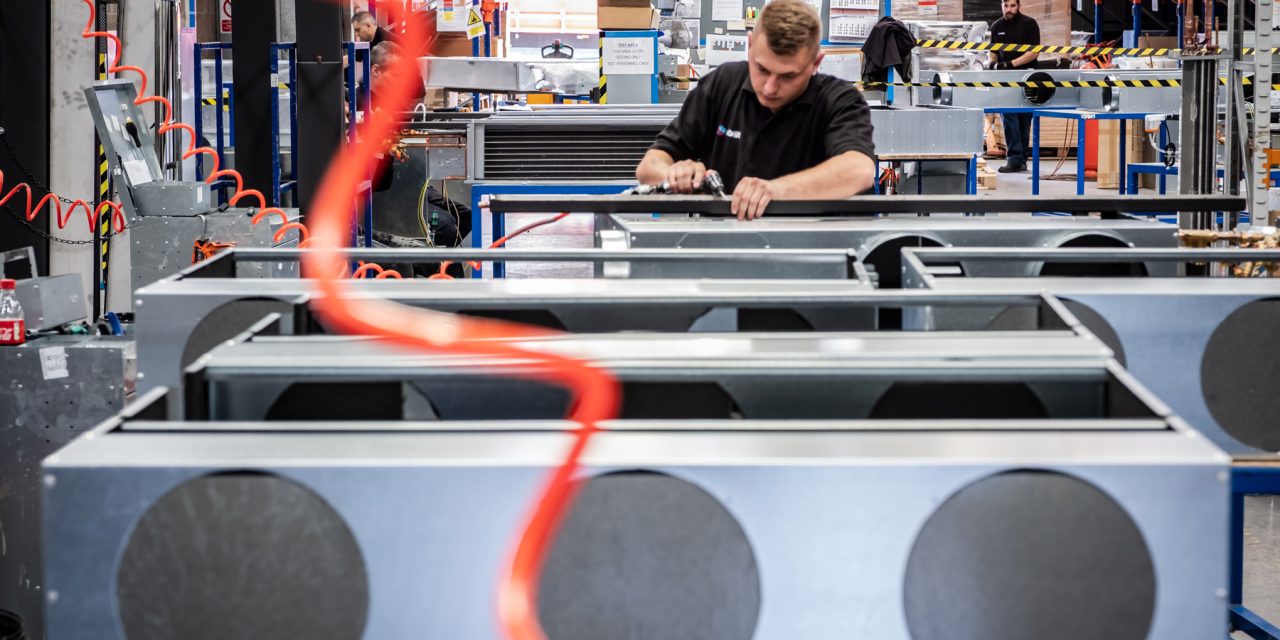
Correct specification of high-performance fan coil units (FCU) can help reduce operational carbon and increase the sustainability of HVAC services in commercial buildings. The challenge is that in many cases, Cat B fit outs can result in FCU waste, increase embodied carbon and undermine sustainability gains. Here, Troy Chambers, Head of National Sales at Ability by Dimplex, looks at the options available to building designers and M&E engineers to help reduce Cat B fit out waste by paying close attention to the fan coil system design at the Cat A stage…
Cutting embodied carbon is a priority for the whole built environment. In 2024, the pilot version of the UK Net Zero Carbon Buildings Standard was launched. The standard covers operational and embodied carbon emissions based on a year of post-occupancy in-use building performance data rather than on modelling in the design stage. Targets will reduce over time, and by 2050, the embodied carbon emission for office will be limited to just 60kg of CO2/m2, compared to 735kg of CO2/m2 in 2025.
While these targets encompass the whole building, perhaps one of the hardest factors to control post-design is Cat B fit out. This supersedes the original Cat A fit out as the landlord tailors the internal space to meet the tenant’s requirements. Equipment and furnishings are often replaced before the end of their natural lifespan, and in the case of new builds, before they have even been used.
This is often the case with FCUs because the custom design of a Cat B fit-out will change the space’s heating and cooling requirements, requiring a re-evaluation of the FCUs’ efficacy.
As a result, without the careful design of FCU system in the design stage, Cat B fit outs can increase carbon emissions and construction waste, while costing extra time and money.
Does going straight to Cat B fit out or specification of smaller FCUs resolve challenges around technology waste?
One option is to go directly to Cat B fit out, although this requires cooperation at the design stage. If the occupant is not known, an office space without flexibility to customise its layout may be less desirable and so may be harder to lease or command smaller premiums. For this reason, it tends to be adopted by large corporations constructing a building for their own use, or where a tenant signs a long-term lease. Even then, any design alterations can create issues if not carefully managed.
An alternative is to fit out and market a limited number of Cat A fitted floors, with the other floors going straight to Cat B fit out once tenants are secured. While this reduces the potential for waste, it also sacrifices economies of scale and means tenants must wait longer as pipework, ductwork and wiring are installed from scratch.

Another option is the use of more, smaller FCUs. While this would reduce waste and the likelihood that adjustments to FCU strategy would be required at the Cat B stage, it also increases the cost to the building owner. Every extra FCU needs a controller, a valve set, and pipework and electrical connection on top of the cost of the unit itself. As a result, the upfront cost associated with purchasing and installing more FCUs may be hard to justify. It may also increase the embodied carbon, both the operational cost and carbon and the solution will require more maintenance.
Examined closely, none of these routes offers a viable solution that reduces FCU waste and embodied carbon while also meeting the needs of both building owners and tenants. The good news is there’s a fourth option – specifying larger, adaptable FCUs that can deliver heating and cooling to multiple rooms.
Larger, adaptable FCUs prevent waste without increasing costs
The benefits of specifying larger, adaptable FCUs during Cat A fit outs is recognised by the UK Government in the ‘GPU Hub Specification’ guidance. This favours the use of adaptable FCUs which have DC motors with multiple fan sections. In turn, this allows individual spigots to deliver independent variable volume supply to multiple control zones. This reduces embodied energy at the design stage because there are fewer units with less pipework, electrical connections and so on.
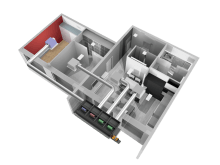
Separate controls allow occupants to tailor conditions to their requirements, preventing issues with overheating or overcooling. With a small software update, a single adaptable FCU unit can control the temperature in up to five separate spaces.
Adaptable FCUs have the added benefit that they reduce waste not just in the initial Cat A to Cat B transition but also for subsequent transitions as tenants leave, and new leases are agreed. That can add up to a significant saving in cost, time, waste, and carbon emissions and make the choice of these FCUs an efficient and sustainable design solution.
Minimising FCU waste at the Cat A stage is key to reducing embodied energy. Adaptable FCUs offer M&E designers a practical, flexible and cost-effective solution that supports the move to Cat B with minimal waste, ensuring that sustainability targets can be met without compromising performance or tenant requirements.
To find out more about adaptable FCUs and to discuss your projects, contact the Ability technical team.