Glenigan, powered by Hubexo (Glenigan), one of the construction industry’s leading insight and intelligence experts, has released the April 2025 edition of its Construction Review. It explores how tariffs have tightened pressure, as project-starts drop 21% as export disruption looms…
The Review focuses on the three months to the end of March 2025, covering all major (>£100m) and underlying (<£100m) projects, with all underlying figures seasonally adjusted.
It’s a report which provides a detailed and comprehensive analysis of year-on-year construction data, giving built environment professionals a unique insight into sector performance over the last 12 months.
Major schemes stall as new starts shrink
Ongoing weakness in project-starts continues to weigh on sector performance. Overall, the project-start rate fell 4% against the preceding three months, with the value of work commencing on-site still trending significantly below last year. Project-starts were down 21% year-on-year, reflecting continued delays in major developments and subdued confidence in underlying schemes.
Major (£100m+) projects remain in short supply, contributing significantly to the annual drop in total project starts. Underlying schemes (<£100m) have also underperformed, posting declines both quarter-on-quarter and year-on-year. Community and Amenity projects performed well in main contract awards, having grown 26% year-on-year and 70% quarter-on quarter, driven by a strong increase in major (£100 million or more) projects. However, despite some momentum at the contract award stage, much of the pipeline has yet to translate into on-site activity.
Planning approvals: A brighter outlook emerges
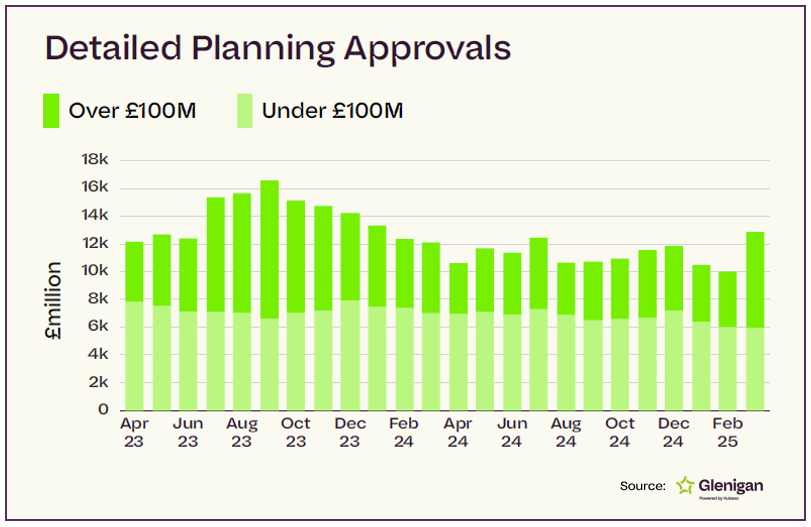
Detailed planning approvals rose 8% against the preceding three months, with growth most prominent in the industrial, health, hotel & leisure, and education sectors. Notably, overall civil engineering planning approvals saw a staggering 176% quarterly increase.
Sector highlights include a 20% year-on-year rise in hotel & leisure approvals, buoyed by sustained investment in hospitality developments. Education approvals also climbed 17% compared to the previous year, with the outlook further supported by a 21% uplift in capital funding for the Department for Education in the 2025/26 budget.
These trends suggest a strengthening development pipeline which, if sustained, could support a rebound in project-starts during the second half of 2025.
US tariffs disrupt export outlook and threaten domestic pricing
The introduction of US tariffs on UK building materials presents a significant new challenge for the sector. General UK goods now face a 10% tariff, rising to 25% for aluminium and steel, key exports in the UK’s £1.01 billion trade with the US, which made up 12% of total building material exports in 2023. With most exports consisting of manufactured components rather than raw materials, UK producers are particularly exposed.
A Brexit-style decline in trade could cost the industry over £130 million. Beyond exports, global suppliers displaced by the US tariffs are likely to pivot toward Europe and the UK, heightening the risk of oversupply and price volatility. Contractors, specifiers and manufacturers are being urged to monitor cost movements closely and act quickly to secure specifications and safeguard market share.
“The sharp drop in project-starts reflects the ongoing struggles within the industry,” says Allan Wilen, Economics Director at Glenigan. “While the surge in major contract awards and detailed planning approvals suggests a strengthening pipeline, real, sustained growth hinges on improved market confidence and the smooth conversion of approvals into on-site activity. The Spring Statement’s 13% increase in departmental capital budgets for 2025/26, particularly in housing, health, and education, is a welcome boost for future workloads.”
To find out more about Glenigan and its construction intelligence services click here.