
Artificial intelligence (AI) is creating new opportunities for reinforcement steel suppliers and construction businesses to reduce costs, improve material efficiency and communicate more effectively with customers. Could smaller businesses be among the biggest beneficiaries?
For many businesses in the construction supply chain, improving efficiency has traditionally meant investing in specialist software, employing additional administrative staff or adapting existing processes to work with the systems available.
That is beginning to change. AI-powered tools are making it easier for smaller businesses to automate repetitive tasks, process technical information and develop systems tailored to their own operations, often without the substantial investment previously associated with bespoke software.
For the reinforcement steel industry, where accurate quantities, competitive quotations, efficient fabrication and dependable deliveries are essential, these developments could have significant practical benefits.
The opportunity extends beyond reducing administrative costs. Better use of information throughout the supply chain could help businesses minimise material waste, reduce mistakes and improve the service customers receive.
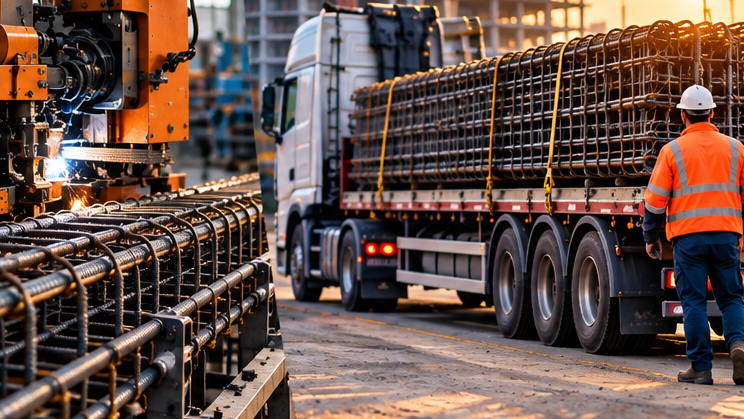
Faster, more accurate reinforcement steel quotations
Preparing a reinforcement steel quotation can involve considerably more than calculating a price per tonne.
Depending on the project, suppliers may need to interpret bar bending schedules, establish steel quantities, identify different bar diameters and shapes, calculate fabrication requirements and account for transport and delivery arrangements.
For complex orders, this can require information to be transferred between drawings, spreadsheets, estimating systems and production records. Each additional manual step introduces the potential for delays or errors.
AI-assisted systems could help streamline parts of this process.
For example, document-processing tools may be able to extract relevant information from bar bending schedules and organise it into a format suitable for checking, estimating and production planning. Quotation systems could then use validated quantities and specifications to prepare consistent estimates more quickly.
This would be particularly useful for smaller suppliers handling a mixture of standard reinforcement products and bespoke fabrication enquiries.
UK suppliers such as Reinforcement Products Online, which operates across reinforcement mesh, reinforcing bar and prefabricated steel reinforcement, work within a supply chain where product specifications, bar dimensions, fabrication requirements and delivery arrangements all influence the ordering process. Bringing these details together efficiently is important for both suppliers preparing quotations and contractors assessing material requirements.
The objective is not to remove experienced estimators from the process. Structural drawings and bending schedules still require careful interpretation, and discrepancies must be resolved before orders enter production.
Instead, automation could reduce the time spent transferring and organising information, allowing staff to concentrate on technical accuracy, customer requirements and commercially important decisions.
Making better use of reinforcement steel
Material efficiency is another area where relatively small improvements can deliver meaningful financial benefits.
Reinforcing steel is frequently supplied in standard lengths before being cut and bent into the shapes required for individual projects. Poorly coordinated cutting plans can generate unnecessary offcuts, increase material requirements and add to production costs.
Cutting optimisation itself is not new. Mathematical methods have been used for decades to identify more efficient cutting patterns, and specialist fabrication software already performs many of these calculations.
What AI could change is how easily smaller businesses access and combine these capabilities with their existing workflows.
An integrated system could bring together bar bending schedules, stock records, available bar lengths and cutting requirements, making it easier to identify opportunities to use materials efficiently.
For example, rather than assessing individual jobs entirely separately, a supplier could examine compatible requirements across several orders when planning production. Usable offcuts might also be recorded and considered for future work where the specifications permit.
Research into reinforcement cutting optimisation has repeatedly demonstrated the potential for reducing material waste through better planning. A 2021 systematic review published in Sustainability identified cutting waste of approximately 3–5% in the literature examined, while noting that more sophisticated optimisation approaches could achieve further reductions.
For reinforcement businesses, reducing waste has two advantages: lower material costs and less unnecessary steel consumption.
However, any proposed changes to reinforcement lengths, lap positions or detailing must remain consistent with the approved structural design. Software should optimise the use of specified materials, not independently alter engineering requirements.
Improving fabrication and delivery planning
Once a reinforcement order is confirmed, attention turns to coordinating materials, fabrication capacity and delivery schedules.
For suppliers producing cut-and-bent reinforcement and prefabricated cages, this requires careful coordination between order processing, stock availability, production teams and transport arrangements.
The manufacture of cut-and-bent reinforcement and prefabricated cages requires coordination between order processing, material availability, production capacity and delivery requirements.
Problems arise when information becomes fragmented. A revised schedule might not reach production promptly, a material shortage may be identified too late, or delivery arrangements may be confirmed without a reliable understanding of manufacturing progress.
More connected systems could make these processes easier to manage.
Order information could feed into production schedules, highlight material requirements and help staff identify potential conflicts between fabrication workloads and delivery commitments.
AI-assisted tools could also support planning by identifying patterns in previous orders, estimated production times and recurring delays, provided the underlying records are sufficiently reliable.
For smaller reinforcement suppliers, this does not necessarily require a comprehensive enterprise resource planning system.
Increasingly accessible development tools and automation platforms create opportunities to build focused solutions around individual operational problems, while retaining established systems for essential business functions.
The potential saving is therefore not simply the cost of a software subscription. It is the cumulative reduction in duplicated work, avoidable errors, unnecessary material handling and administrative time.
Better communication with construction customers
Although cost and material efficiency are important, one of the most valuable improvements could be much simpler: keeping customers better informed.
For contractors organising concrete pours, reinforcement installation and site deliveries, accurate information about an order can be just as important as the initial price.
Customers need to know whether a quotation has been received, whether specifications require clarification, when an order is likely to be ready and whether delivery arrangements have changed.
When these updates depend entirely on individual telephone calls and email exchanges, communication can become inconsistent, particularly during busy periods.
Connected quotation, production and customer management systems could help address this.
An enquiry could be acknowledged automatically, outstanding technical information flagged for review, and customers updated when an order reaches an agreed production or dispatch milestone.
AI could also help staff organise correspondence, summarise lengthy enquiry threads and prepare clear responses using verified order information.
The distinction between automated communication and useful communication is important, however.
A confidently written but inaccurate delivery update could cause more disruption than a delayed response. Similarly, automatically generated quotations must not be mistaken for technically approved offers.
The most effective approach would combine better information management with experienced staff retaining responsibility for important technical decisions, commitments and customer relationships.
For smaller construction suppliers, that could mean delivering a more consistent level of customer service without continually increasing administrative overheads.
New opportunities bring new responsibilities
The growing accessibility of AI-supported business tools also introduces risks that should not be overlooked.
A small business may now be able to create an internal quoting application, production dashboard or customer management tool at relatively low cost. But producing software that appears to work is not the same as producing software that is secure, accurate and reliable.
Systems handling customer contact details, commercial quotations, project documents or financial information require appropriate access controls, secure data storage and ongoing maintenance.
Applications exposed to the internet can also become targets for automated vulnerability scanning and exploitation. Poor authentication, insecure configuration and unnecessary exposure of customer records can create serious problems for businesses that may have little experience managing software security.
The same caution applies to the information AI systems produce.
An incorrectly interpreted bar bending schedule, inaccurate quantity calculation or fabricated delivery commitment could have consequences extending well beyond a simple administrative inconvenience.
Businesses adopting these tools need to consider testing, data protection, staff oversight and responsibility for maintaining the systems over time.
AI can reduce the technical barriers to developing useful tools, but it does not remove the need for sound engineering judgement, proper security or accountable business processes.
A practical opportunity for smaller reinforcement businesses
The wider construction industry has long recognised the potential benefits of digitalisation, but smaller businesses have not always had the resources to invest in sophisticated systems.
AI could help narrow that gap.
For reinforcement steel suppliers, the most valuable applications may not involve dramatic changes to fabrication machinery or structural engineering. They may instead be found in everyday activities: preparing quotations, coordinating production, reducing material waste, organising deliveries and communicating with customers.
These are established operational challenges, and improvements in each area can contribute to a more efficient and competitive business.
The real opportunity lies in applying AI selectively, alongside established automation and professional expertise, to solve problems that already cost businesses time and money.
For smaller reinforcement suppliers and their customers, that could prove far more valuable than adopting AI simply for its own sake.