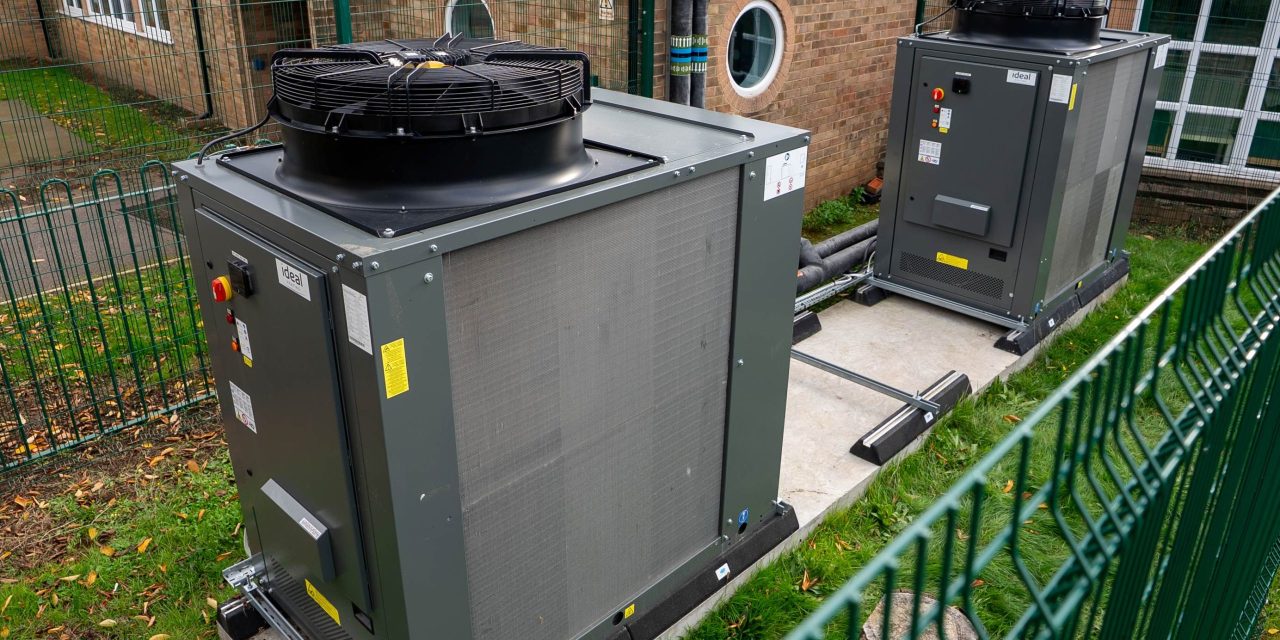
Ideal Commercial Heating has launched a new CIBSE approved CPD designed to help heating professionals understand the safety considerations associated with commercial air source heat pumps that use R290 refrigerant.
Entitled ‘Safety considerations for R290 commercial air source heat pumps: Understanding the practical application of flammable refrigerants in commercial heating’, the CPD is aimed at consultants, designers, specifiers, contractors and engineers involved in the design, installation and maintenance of commercial heat pump systems.
R290 – the common choice
As the commercial heating sector transitions towards lower global warming potential (GWP) refrigerants, R290 is becoming an increasingly common choice. The natural refrigerant, commonly known as propane, has a GWP of just three and an ozone depletion potential of zero, while also supporting high operating temperatures suitable for commercial heating applications.

As an A3 refrigerant, meaning it has low toxicity but high flammability, R290 requires an understanding of and confidence around safe design including risk assessment, specification, installation, commissioning and ongoing maintenance.
Ideal Commercial Heating’s new CPD has been designed to help close knowledge gaps and provide clear, accessible guidance for those working with or considering R290 systems.
The CPD provides an overview of refrigerant classifications and the regulatory framework surrounding the use of flammable refrigerants. This includes the Dangerous Substances and Explosive Atmospheres Regulations 2002 (DSEAR), together with relevant technical standards and guidance such as BS EN 378 and EN 60079-10-1.
Participants are guided through the DSEAR risk assessment process, including identifying hazardous substances, assessing the likelihood of a refrigerant release, defining hazardous zones, identifying potential ignition sources and implementing appropriate control measures.
A major focus of the CPD is the practical application of exclusion and safety zones around commercial R290 heat pumps. It explains how the required zones are influenced by factors including refrigerant charge, possible leak scenarios, ventilation conditions and the geometry of the installation.
The CPD also considers the way propane behaves in the event of a leak. As R290 is denser than air, it can accumulate in low-lying areas such as drains, pits, manholes, cellars and other depressions.
The CPD therefore examines how the positioning of heat pumps, building openings, ventilation intakes and possible ignition sources can affect installation safety. Practical examples cover several common commercial installation arrangements, including free-field ground installations, units positioned in front of walls or within corners, cascade installations and flat-roof applications.
Further topics include minimum service and efficiency clearances, leak detection, hydraulic circuit safety and the use of deaerators. The presentation also explains why competent maintenance is essential throughout the operational life of an R290 system, covering requirements such as safe working zones, R290-compatible leak-detection equipment, inspections of exclusion areas and regular calibration of propane detectors.
This latest CPD forms part of Ideal Commercial Heating’s comprehensive CPD programme, which supports commercial heating professionals by developing their knowledge of evolving technologies, regulations and best practice.
It is delivered by Ideal Commercial Heating’s experienced specification team either online or in person nationwide. To learn more about Ideal Commercial Heating’s CPD programme, or to book a place, visit idealcommercialboilers.com/