Commercial facilities rely on continuous access to maintain profitability. Even short periods of downtime at office buildings, warehouses and logistic centres can have a cascading effect on business productivity. But what happens when the problem lies beneath the surface – and entirely outside a facilities manager’s control? Here, Jon Chevin, commercial and infrastructure director at geotechnical specialist Geobear, explores how advanced ground engineering techniques can simplify complex commercial projects…
The stability of commercial properties is threatened by the increasing volatile weather conditions brought by climate change. And that’s only set to increase. A report produced by the UK Met Office and released in May 2026 by the World Meteorological Organisation said there is an 86% chance that at least one year between 2026 and 2030 will surpass 2024 as the hottest year ever recorded.
Heavy rainfall and prolonged dry spells will weaken the structural stability of building foundations, increasing the risk of subsidence events. When foundations begin to falter, business owners and facility managers must seek remediation techniques to ensure employee safety and maintain commercial operations. Addressing ground instability often requires extensive remediation work that can restrict site access for weeks or even months. The result is costly operational disruption, lost revenue and increased pressure on businesses already contending with climate-related risks.
Shutting down operations with traditional methods
Ground instability and subsidence is typically addressed with subsurface engineering methods, requiring excavation to remove defective foundations. After removing the unstable material, contractors fill the resulting voids with concrete or cement to stabilise the supporting ground. However, sourcing, transporting and coordinating these materials can create logistical bottlenecks, delaying remediation works and extending project timelines.
Excavation methods also introduce large engineering teams and heavy plant on site, meaning public access cannot be granted during works. A concrete curing period is also required after completion, further delaying a return to normality for commercial assets users.
Beyond the immediate operational impact, prolonged ground engineering works can also affect confidence in a site itself. Concerns around safety, accessibility and ongoing disruption can place added pressure on facilities managers and contractors to resolve issues quickly while minimising impact on business continuity.
Ensuring access with advanced ground engineering techniques
To minimise downtime, contractors are assessing alternative ground engineering techniques that minimise disruption while maintaining access to occupied buildings. One such approach is geopolymer resin injections, a targeted remediation method designed to stabilise foundations without the need for excavation.
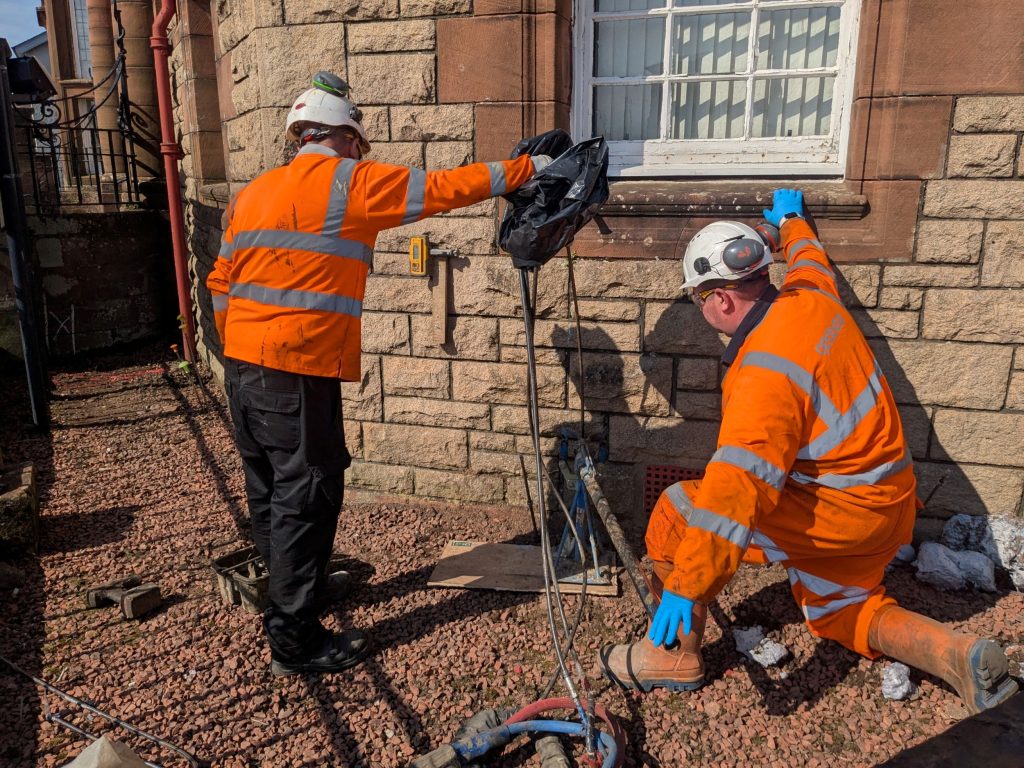
Rather than removing existing foundations, technicians drill small access points into affected areas and inject specialised expanding resin beneath the structure. The resin fills underground voids, compacts weak soils and restores ground stability with minimal surface disruption. Because the process is highly targeted, there is no requirement for extensive excavation, large engineering teams or heavy machinery.
The flexibility of resin injections allows employees, visitors and operational teams to maintain building access, ensuring day-to-day activities and businesses can remain operational.
Unlike the curing period for traditional methods, the resin hardens immediately after injection, reaching full strength and stabilising foundations quicker than concrete. Affected areas can return to service quickly, reducing disruption for building occupants. This rapid curing allows contractors to shorten overall project timelines, ensuring business operations can return to normal faster.
Museum and council offices restored with minimal disruption
The benefits of minimally disruptive remediation were demonstrated at Burnet Building, a Grade A-listed museum and local council office, located close to the Campbelltown Loch, Scotland. The building had experienced subsidence since the early 2000s, as high tides from the Loch had gradually washed away fine soils beneath the structure.
Argyll and Bute Council required a remediation technique that would not damage the historic building’s features while allowing day-to-day operations to continue unaffected. This meant traditional underpinning methods were impossible. Seeking an alternative option, the council reached out to Geobear to compete a ground improvement regime.
Technicians developed a targeted solution, injecting geopolymer resin into 250 points, reaching two meters below the primary load-bearing walls. Over 15 days, Geobear compacted the ground, restoring stability the foundations. By avoiding large-scale excavation, the project addressed underlying ground instability while allowing disruption to the buildings daily activities to be kept to a minimum.
Amy Wemyss, surveyor at Argyll and Bute Council, comments: “The building is almost 130 years old and is a significant feature to the local community. We needed to maintain access for daily council operations, so a neater and quicker remediation technique was needed.”
As commercial property owners seek to minimise downtime, contractors require remediation methods that address ground instability without shutting operations down. Geopolymer resin injections can ensure that essential ground engineering techniques are completed, while maintaining access to occupied buildings, helping commercial businesses to remain productive throughout essential remediation.