People counting technology has long been used in retail as it helps get a clear idea of the flow of customers. In recent years, people counting sensors for retail have even taken this further to help retailers understand how customers move within the store, information that’s then used to optimise layouts, marketing campaigns, and product replacement.
This same need for visibility has made people counting move beyond retail to public buildings. From transport hubs to municipal offices and museums, these buildings are facing the same pressures to understand how their space is being used for more effective management. It’s then further compounded by public pressure for greater accountability and privacy-conscious systems.
How people counting sensors became standard in retail
People counting systems in retail have come a long way from the 90s, when automated systems started replacing manual counting and gut-feeling assessments of store traffic.
In the 2000s, the technology moved from infrared beam breakers to camera-based systems to help increase accuracy. However, in the late 2010’s, radar-based people counters became the gold standard for people counting under pressure from the GDPR and other privacy regulations.
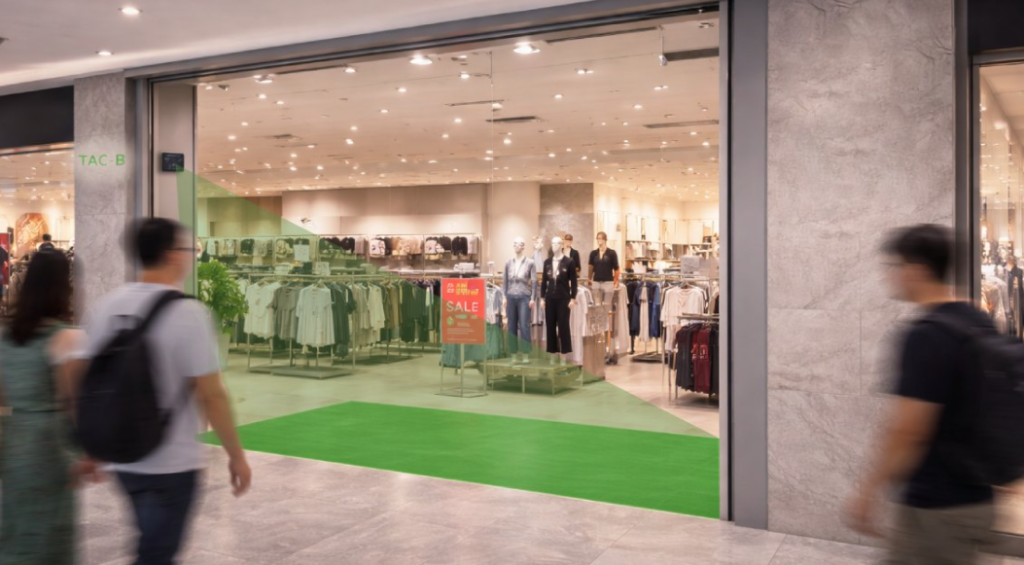
These sensors don’t record any images or personal data, but they can accurately count visitors as they enter and even track them throughout the store until they exit.
Industry-leading sensors like the SensMax TAC-B range can cover up to 100m2 per sensor using 60 GHz millimetre wave (mmWave) technology and multiple configurable counting zones.
From footfall tracking to performance insights
When managers track visitors at the entry point, they can get a clear idea of traffic flow by the hour, day, week, or month. This makes it easier to plan cleaning and schedule staff efficiently, avoiding long queues or overstaffing.
However, that’s just the basic people counting. Radar-based sensors provide useful information about customer behaviour, such as the aisles they spend the most time in. They can also see the areas that tend to get overcrowded and adjust the store layout.
Businesses can also correlate traffic data with sales data to gain deeper insights, such as which aisles receive traffic but rarely sell.
Why public buildings are now adopting the same approach
Public buildings may not need to correlate sales with traffic, but they definitely need to understand the flow of visitors and the usage patterns of different offices, transport hubs, museums, and libraries.
The information collected by sensors can be sent to online servers in real time, then presented in a dashboard to provide clear management insights. This can then help optimise schedules and operations in different ways.
Rising demand for occupancy visibility
Traffic in public buildings tends to be high most of the time, but it also varies significantly across times of day, days of the week, and different periods of the month and the year.

Traditionally, managers were just working with assumptions and rough estimates, like rush hour or tax periods. Understanding the actual patterns is quite crucial in efficiently allocating public resources. Operations managers also have clear visibility into traffic flow and can make necessary adjustments when visitor traffic exceeds expectations.
Operational efficiency and cost control
Cleaning schedules and staffing are often planned by assumption, which often leads to overstaffing or understaffing. When managers have access to actual traffic trends by the hour or day, they can optimise schedules to reduce operational costs without compromising comfort.
Safety and compliance considerations
When managers monitor traffic flow, they can easily abide by safety and regulatory compliance requirements. They can prevent congestion in transport hubs, and managers can send additional staff to help with crowding. Buildings that track traffic flows over days and weeks are also much better equipped to prepared to unexpected events.
A privacy-first alternative to camera-based systems
Public buildings and parks, by extension, are using sensors to track data as camera-based systems offer lots of complexities.
First, they fall under GDPR privacy regulations as they capture and process facial data. Most modern ones also use AI to analyse footage, bringing them under the new EU AI Act.
Radar-based people counters like the SensMax TAC-B 4G Outdoor People Counting Radar don’t capture any images or collect personal data. Instead, they use 60 GHz mmWave radar to detect people’s movement with details like speed and direction.
The technology therefore provides accurate data while avoiding the complexities of privacy regulations. Public buildings can optimise operations and staffing without unnecessary overhead or non-compliance risks.