More than 80 members of the MCRMA gathered in Telford recently for the 2025 MCRMA Technical Conference to discuss the key issues affecting the metal cladding and roofing sector.
The stand-out message proved to be the importance of increased collaboration to meet numerous compliance, sustainability, performance and quality goals.
The two-day conference, sponsored by Firth Steels, Fixing Point, Hambleside Danelaw and Steadmans, provided an opportunity for representatives from MCRMA member companies to hear from leading figures within the construction sector, as well as specialists within its membership discussing a range of technical topics. The agenda sought to provide a combination of top level strategic thinking and practical insights to help members improve their business processes and optimise the performance of their products and systems.
Compliance obligatory ‘from the shed to the Shard’
After a welcome from recently appointed MCRMA Chair, Adrian Whitefoot, the programme began with a presentation from Neville Grunwald, Director of Facades at Wates, on competency across the supply chain. As one of the industry’s most prominent figures supporting change in the construction industry through his work with the JCI (Joint Competence Initiative), Neville took the opportunity to tackle the myth that the Building Safety Act only applies to higher risk buildings (HRBs).
He quoted Peter Baker, a former head of the Building Safety Regulator, who used the phrase ‘from the shed to the Shard’ in relation to how new safety requirements apply. This powerful quote neatly summed up Neville’s main point that competence has to be demonstrated by member companies involved at all stages of all projects.
The second presentation by Andy Crooks, Managing Director of Planet Building Control, built on many of the themes associated with competence and compliance with insights from a building control perspective. He focused on the role that dutyholders play and the competence requirements for all those in the metal cladding and roofing supply chain, as well as how to stay compliant with the Building Regulations.
After explaining the obligations and responsibilities of the client, principal designers, designers, principal contractors, contractors and building control, Andy went on to talk about four key areas to consider in relation to competence – behavioural, legal and regulatory, management and technical. He wrapped up the presentation with an assertion that many of those working in construction already have the knowledge and skills to comply under the new safety regime, but they need to understand how to document it correctly.
Latest updates on the CCPI
Sticking with the topic of Building Safety Act compliance was the third presentation by Amanda Long, Chief Executive of the CCPI (Code for Construction Product Information). Her presentation sought to refresh members on the importance of the CCPI and the value of the code in ensuring misleading or inaccurate claims about product performance are eliminated from the building design and specification process.
Amanda provided delegates with an update on the progress and development of the code. It now extends beyond its original product manufacturer remit to provide certification for merchants and distributors seeking to provide clarity, as well as Tier 1 contractors and insurance companies who want to demonstrate their preference for CCPI registered suppliers.
Contractual versus regulatory risk
The second afternoon session was a presentation by Gavin Hoccom, Partner and construction team lead at Browne Jacobson, who specialises in advising clients on complying with the new building safety regime. He took the opportunity to explain to members how the regulation of ‘manufacturers as designers’ works, highlighting the distinction between contractual risk and regulatory risk and the potential consequences for businesses who fail to comply under both aspects of the regulations.
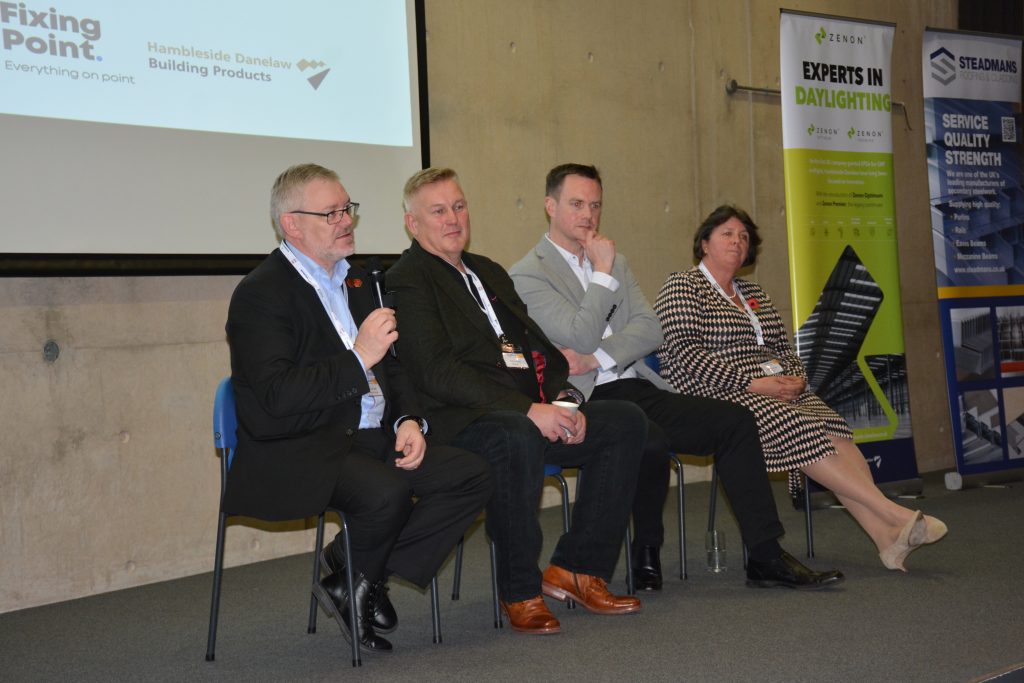
The first day concluded with a panel discussion, giving members an opportunity to ask whatever questions they had relating to regulations, compliance and competence.
Learning from building envelope failures
Day two was focused more on the technical aspects of metal building envelope systems and sustainability. It kicked off with a joint presentation on ‘What happens when things go wrong?’ by independent inspectors Barry Jackson and Nick Selves, with the aim of showing where potential issues can occur along the supply chain.
They highlighted various projects in which they had been asked to assess issues and advise upon where the metal cladding or roofing installation had failed. Barry’s presentation concentrated on an industrial unit’s metal roof that had failed with severe water ingress resulting. The issues ranged from installation not in accordance with the manufacturer’s recommendations and lack of perimeter sealing, to insufficient and poorly conceived fixing patterns and numerous rooflight failings.
Nick took the opportunity to flag up ‘incompetency in the supply chain’ using an example of a rainscreen cladding project where a combination of poor design and inferior workmanship had resulted in a significant claim. He also shared insights into an award winning multi-faceted building design project that needed to be significantly altered when it became unfeasible at the design detailing stage. This was due to the original architect’s failure to consider practical issues such as drainage, buildability and future maintainability.
Insights into structural performance, sustainability and fastening best practice
Martin Heywood, Director of Newton Launch Systems, continued the technical section of the conference with a presentation about the structural performance of metal cladding systems. Along with an overview of different loads and the testing involved, he reinforced a point made by previous speakers that a systems-based approach to roofing and cladding may be extremely beneficial under the new safety regime in terms of providing assurance on performance, given the ability to test complete systems in a laboratory environment.
Concluding the formal presentations, Barry Rust, Head of Market and Business Development at Tata Steel, explained how his company is moving to carbon neutral steelmaking through its significant investment in an electric arc furnace (EAF) at Port Talbot. He also explained the process that Tata Steel undertakes for providing environmental product declarations (EPDs), as well as the challenges that the sector faces as a whole in relation to EPD consistency and carbon reporting.
The afternoon of day two concluded with two panel discussions. The first was on sustainability, involving member companies Firth Steels, Tata Steel and UKWS, giving delegates the opportunity to question panellists on this increasingly important area, as well as hear how their businesses are navigating the carbon reduction and market challenges.
The final panel discussion was on fastening and fixings, with representatives from three of the MCRMA’s member companies – Fixing Point, Fixfast and SFS Group Fastening Technology – taking part in a Q&A session. A host of topics were discussed over 60 minutes, including fastener considerations in refurbishment projects, the ongoing issue of installers using impact drivers instead of recommended screw guns and the extent to which fastener suppliers should be involved in the cladding and roof design process.
‘Thank you to all MCRMA members’
Adrian Whitefoot, Chair of the MCRMA, comments: “Thank you to all the MCRMA members who attended our 2025 Technical Conference as well as our speakers, panellists and sponsors.
“With so much change in the construction sector currently, it is no surprise that there are as many questions raised as answers provided in respect of the new regulations and obligations, and this is why events like this can be so valuable to members.

“The MCRMA looks forward to continuing our support for the industry throughout 2026 through our new guidance documents, updates to existing resources and CPDs, as well as facilitating easier access to training, both via the association’s own training and that available through member companies.
“I look forward to us regrouping at the next Technical Conference, details of which will be announced next year.”
Find out more about the MCRMA at www.mcrma.co.uk.