Across the housing sector, procurement teams are under increasing pressure to make decisions that balance safety, compliance, cost, long‑term sustainability and accountability. Yet comparing fire doorsets is rarely straightforward, and the gap between what appears compliant on paper and what has actually been proven under controlled, repeatable testing, is widening. Grady Doors has more…
Marketing brochures often reference test performance, but not all test data is created equal, and not all claims reflect how a doorset will behave once installed. In this article, we take a look at how fire door testing works, highlighting the importance of complete system testing for confident procurement.
The key question: Has the fire doorset been tested as a complete system?
Fire door specification often falters when isolated component tests are mistaken for evidence of complete doorset performance. Small‑scale or indicative testing of individual elements, such as hinge, closer, glazing system, or intumescent material, cannot demonstrate compatibility, interaction, or behaviour under fire conditions. In contrast, full‑system testing assesses the complete doorset providing a valid and defensible proof of how the assembled system will perform in service.
Procurement teams often receive technical data sheets that reference “tested components” or “tested materials”. Without context, these claims can appear reassuring, but they may not reflect true compatibility or proven performance when those components are brought together within the overall tested system.
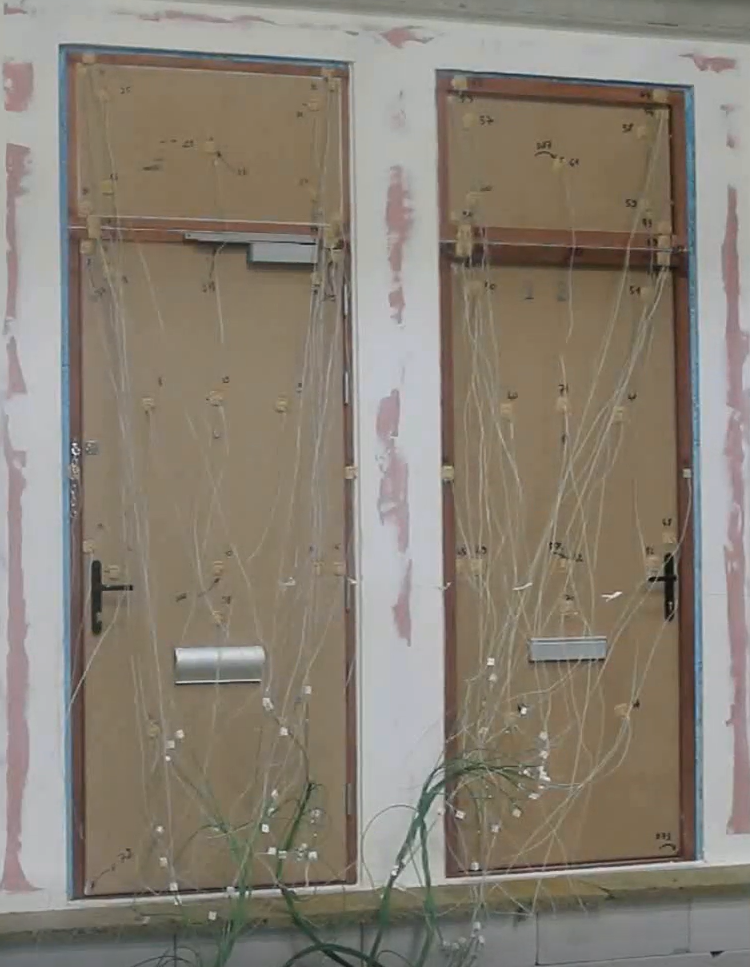
How fire door testing actually works
One or two single tests tell you almost nothing about the inherent safety margins built into a product, nor do they reveal where the weakest points lie.
A competent manufacturer does not test “typical” fire doors. They test the most onerous, most challenging configurations within their range. These edge‑case tests are essential because, to some extent, they reveal the limits of the system and expose how components interact under stress.
It is only through repeated testing of multiple different configurations – leaf sizes, hardware combinations, glazing formats, frame materials, gap tolerances and installation variables -that the true extent of a system’s capability can be understood from a design engineering and responsible product stewardship perspective.
Understanding failure: test behaviour vs real‑world behaviour
By interrogating a wide range of test outcomes across multiple performance characteristics, informed manufacturers can begin to understand not only how a product will behave under the standard test conditions, but how it is likely to perform in service over its lifetime. This is the foundation of modern performance engineering.
A fire door system is a balance of interdependent factors. A seemingly minor infraction – an inconsistent seal, an installation tolerance issue, a glazing bead weakness – can initiate a chain of events that leads to sometimes catastrophic failure. Without deep testing experience, these relationships remain invisible.
The General Safety Requirement: a shift in mindset
With the General Safety Requirement approaching, manufacturers must adopt a fundamentally different mindset. They are required to undertake robust, evidence‑led risk assessments of their products, considering realistic and reasonably foreseeable scenarios across the entire lifespan of the fire doorset and then they must demonstrate that they have mitigated these identified risks.
Manufacturers who have invested in broad, multidisciplinary testing – fire resistance, smoke control, durability, operability, security, mechanical performance and more – are already ahead. They understand how different performance characteristics rely on one another, and how weaknesses in one domain can compromise another.

The market’s fixation on single test reports obscures the reality: fire door safety is a system property, not a single test artefact.
True assurance comes from:
- breadth of testing;
- understanding of failure modes;
- evidence‑led engineering;
- transparency about system limits;
- continuous evaluation of risk.
This is the direction the sector must move in if it is to deliver fire door systems that perform not only in the test house, but in real buildings, under real conditions, for decades.
To visit Grady Doors website, click here.