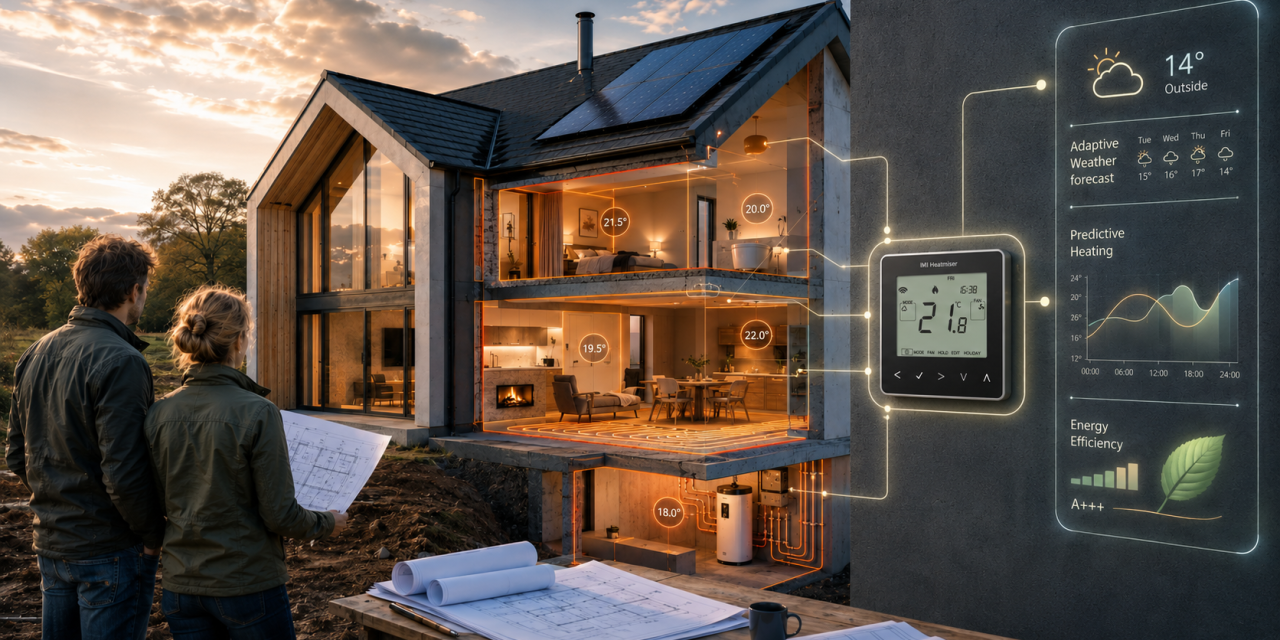
 Tom Sheppard, Head of Product at IMI Heatmiser, explains the role AI plays in the changing role of heating controls in this guest article…
Heating today presents a clear challenge for the industry. How do you balance comfort with lower energy use, ensure homes stay warm without overheating, and get the best performance from increasingly low-carbon heating systems?
As more people look to create more efficient buildings that are future-ready and comfortable to be in, the practical realities of day-to-day heating control are becoming harder to ignore. Adaptive heating controls are becoming far more than a simple add-on to the wider system. Once seen as little more than a wall thermostat or a timer in an airing cupboard, they are now emerging as a critical layer in overall residential building performance.
Where the market stands today
Heating is far more complex than many consumer technology brands first anticipated. Google’s decision to stop launching new Nest thermostats in Europe, sell existing European models only while supplies last, and end support for earlier Nest Learning Thermostat models highlights the challenge of long-term smart-home product support in complex heating markets.
European and UK homes have diverse hydronic systems, varied building fabric and unique compliance requirements that demand deep heating expertise as well as software capability.
Heating control is about understanding how buildings behave in the real world, which comes with a set of practical challenges. Home and building owners are increasingly seeking ways to balance comfort and energy efficiency, optimise the performance of low-temperature heating systems, and heat homes more intelligently around changing occupancy patterns.
Regulatory compliance
In housebuilding, Part L and the Future Homes Standard are also pushing the market towards greater smart zoning, improved efficiency and more responsive controls. In many refurbishment projects, separate control of living spaces is increasingly expected. That reflects a wider recognition from the Government that smarter control is one of the most effective ways to reduce energy demand without compromising comfort.
Multi-zone control allows occupants to heat spaces only when required, helping to reduce energy consumption while maintaining comfort where it matters most. The challenge, however, is that comfort and efficiency do not always naturally work together. That is where adaptive and predictive technologies are beginning to change the conversation.
The role of AI
Traditional smart heating systems have largely been reactive. Features such as pre-heat functions typically rely on historical data, often analysing around 30 days of usage, to estimate how long a property takes to move between temperatures.
However, homes are inherently dynamic environments. Outdoor temperature fluctuations, solar gain, occupancy patterns, floor slab temperatures, heat loss through windows, and a building’s thermal mass all influence how a property responds at any given time.
This is where AI-driven adaptive heating offers a step change, helping homeowners better balance comfort and energy efficiency by responding to real-time conditions rather than relying solely on past behaviour.
A recent paper from the University of León in Spain, ‘Efficient Heating System Management Through IoT Smart Devices‘, explored how intelligent heating systems can use real-time data and predictive analytics to optimise both comfort and energy performance. The study identified energy savings of up to 15%, with IoT-enabled systems delivering measurable reductions in heating demand while maintaining occupant comfort. It also highlighted the potential for machine learning and predictive control to further improve efficiency through the use of weather forecasting, occupancy data and behavioural modelling.
More broadly, emerging research into adaptive comfort suggests that AI-enabled systems are increasingly able to anticipate occupant behaviour, predicting when users are likely to adjust temperatures even before they interact with controls themselves.
Integrated comfort control
Looking ahead, the role of heating controls will continue to expand. The future lies in integrated climate management ecosystems that bring together heating, cooling, ventilation, lighting and energy management into a single intelligent platform. Rather than simply adding smart devices, homeowners will increasingly seek joined-up solutions that reduce energy consumption, improve comfort and simplify the management of heating and cooling across the home.
AI will undoubtedly have an increasing role to play, but it remains early in its maturity.