Mitsubishi Electric is launching a new air-to-water heat pump – ‘The Little One’ – designed specifically with Britain’s new homes in mind, helping developers and housebuilders prepare for the changes being introduced by the Future Homes Standard.
Mitsubishi Electric has announced the launch of its new compact Ecodan air-to-water heat pump, and that it will be available in2027, in time for the introduction of the Future Homes Standard.
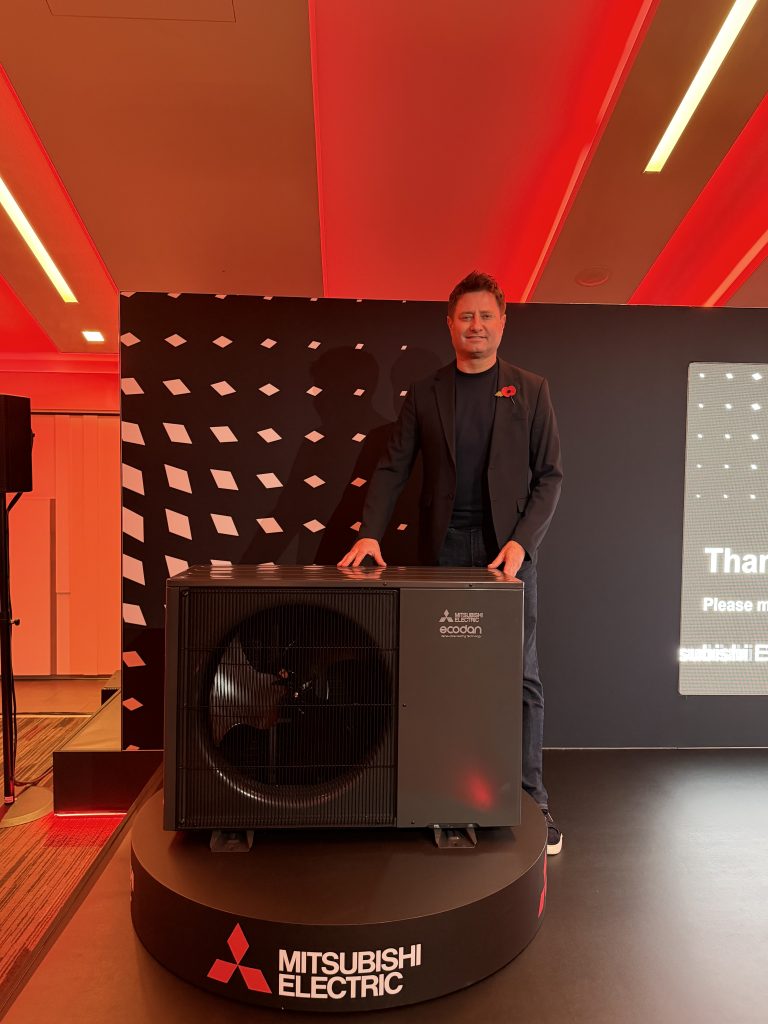
About The Little One
The latest addition to Mitsubishi Electric’s Ecodan range has been developed to address three of the biggest challenges identified by housebuilders when considering heat pumps for new homes: space, installation location and cost.
Available in 4kW and 6kW models, The Little One combines a significantly more compact design with high efficiency, reduced weight and quieter operation, giving developers greater flexibility when specifying and installing low-carbon heating systems.
At 47% smaller and 40% lighter than its sibling, The Little One weighs just 58kg. Its compact dimensions of 970mm high, 713mm wide and 400mm deep make it easier to transport, handle and install, while helping address the space constraints often encountered on new-build developments.

A key innovation is Mitsubishi Electric’s patented Bossless Fan technology, which contributes to the unit’s reduced weight and quieter operation. Sound power levels are just 49dB(A) for the 4kW model and 51dB(A) for the 6kW model, making it quieter than the already Quiet Mark models in the Ecodan range.
Another significant development is the unit’s patented refrigerant technology. By incorporating an odorant into the R290 refrigerant, Mitsubishi Electric has overcome the need for a protective zone around the unit.
This removes a number of restrictions on where the heat pump can be positioned, giving housebuilders and installers greater freedom when planning layouts and selecting installation locations whilst being able to specify the ultra-low GWP (Global Warming Potential) R290 refrigerant.
Despite its smaller footprint, The Little One delivers impressive efficiency. At a 35°C flow temperature, the 4kW model achieves a Seasonal Coefficient of Performance (SCOP) of 4.77, while the 6kW model achieves 4.65. Both models are best in class with A+++ energy efficiency rating.
The new range has also been developed to offer a more cost-effective option for developers, with Mitsubishi Electric achieving significant cost savings compared with its existing R32 and R290 offerings, without compromising on engineering quality and improving performance.
The launch comes as the Future Homes Standard moves closer to implementation, with heat pumps expected to become the predominant heating technology in new homes. As building fabric and energy efficiency improve, lower heat losses will allow smaller, appropriately sized heating systems to meet household requirements.
Joanna Crown, Product Marketing Manager for Mitsubishi Electric said: “Housebuilders are facing a significant period of change as the Future Homes Standard approaches, and we understand that delivering low-carbon heating at scale means addressing the practical challenges of space, installation flexibility and cost.
“We have listened to developers, installers and social landlords and taken their feedback directly to our research and development teams. The result is The Little One: a heat pump designed around the needs of British homes and the people building them.
“By making the unit considerably smaller and lighter, reducing noise, removing the need for an R290 protective zone and delivering excellent efficiency at a more competitive cost, we believe we have created a product that makes specifying and installing heat pumps easier for housebuilders.
“The Little One demonstrates how innovation can help make low-carbon heating a practical and attractive choice for the next generation of homes.”
The Little One reinforces Mitsubishi Electric’s commitment to developing heating solutions that support the transition to more energy-efficient homes, combining the company’s heat pump engineering experience with a product designed to meet the specific requirements of Britain’s new-build market.