
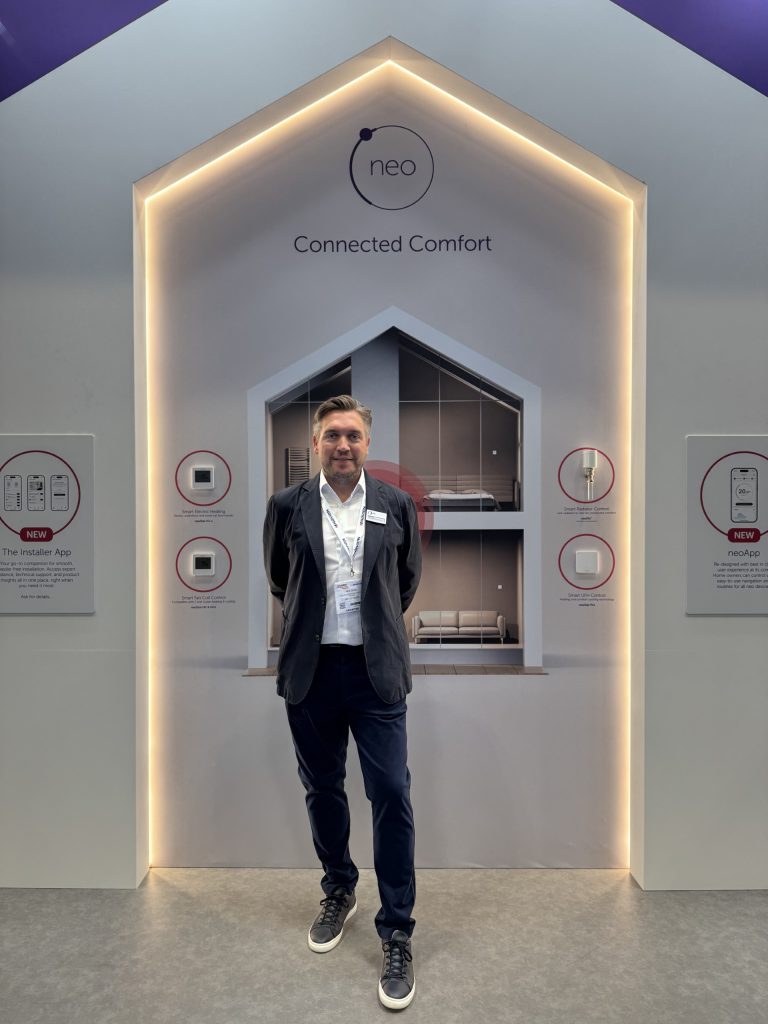
 Neil Budd, Head of Residential Sales at IMI Heatmiser, discusses what the Future Homes Standard (FHS) really means for heating controls – beyond heat pumps and fabric efficiency…
As the Future Homes Standard (FHS) drives demand for more energy-efficient and lower-carbon homes, developers are facing new challenges in balancing compliance, comfort and long-term performance.
Since its formal integration into the UK’s Building Regulations, particularly through updates to Part L (Conservation of Fuel and Power), housebuilders and developers have been working to align specifications and delivery models with these requirements.
However, the FHS must be approached holistically, recognising how these elements work in parallel. Crucially, the conversation also needs to focus on what sits at the centre of the modern heating system, which is, intelligent controls.
Delivering comfort and efficiency
As the industry moves towards low-temperature heating, the role of controls is becoming far more important than simply switching heating on and off. The challenge now is delivering comfort, energy efficiency and system performance together, rather than sacrificing one for the other.
Heat pumps and underfloor heating (UFH) are naturally aligned because both operate efficiently at lower flow temperatures. However, achieving real-world performance across an entire home is more complex. Developers are increasingly specifying mixed systems, with wet UFH downstairs, radiators or skirting heating upstairs, electric UFH in bathrooms, and in some cases heating and cooling integration too. This creates a clear need for a more rounded control strategy.

Requirements of the Future Homes Standard
Historically, heating systems were relatively simple, as homes were fitted with a boiler, radiators and a programmable thermostat. But under the FHS, the requirements are different. Heating generation, emitters, hot water and smart home integration are now interconnected parts of one ecosystem. Controls must evolve to manage that complexity while remaining simple for homeowners to use.
That means, in terms of the FHS developers, should be thinking beyond standalone thermostats, and considering integrated whole-home control platforms that are capable of managing multiple heating types from one app, creating one user experience.
Open-loop and micro-zoning
The industry must avoid becoming overly polarised between open-loop systems and aggressive micro-zoning. There is no single solution for every property type or homeowner, given the wide range of influencing factors such as location, construction materials and property size. Every home is different, as are the needs and expectations of the people living in them.
Some homes may benefit from carefully grouped zones, for example, rather than individual room-by-room control. Others may require more flexibility to compensate for solar gain, occupancy patterns or overheating risks in living spaces. End users often still want visible, intuitive control over comfort levels in their homes, and that expectation cannot be ignored in pursuit of theoretical efficiency gains. The key is finding the middle ground between comfort and optimisation.
Smarter controls bridging the gap
With smart controls, features such as adaptive pre-heat, geofencing and tariff-led optimisation can improve efficiency without compromising comfort expectations. Self-learning systems are also becoming increasingly important, allowing controls to adapt automatically to how homes are actually used.
This is especially important as many heat pump control interfaces remain overly complicated for homeowners. Developers need systems that are easy to install, straightforward to commission and intuitive for occupants to operate day-to-day.
Part L compliance also continues to shape specification decisions, although it is often misunderstood or interpreted differently across the market. Most housebuilders are already moving beyond simply ticking regulatory boxes. Instead, they are looking at how controls can support broader low-carbon housing strategies while still delivering homes buyers actually want to live in.

Future flexibility
Many developers are now considering how homes can be upgraded over time. For example, a property may initially be specified with radiators upstairs, but designed so that additional smart zoning, UFH integration or advanced heat pump controls can be added later through the same connected platform.
The cost of upgrading controls remains relatively small within the overall value of a new home, yet the long-term benefits can be significant. Unlike purely aesthetic upgrades within a home, intelligent controls is a future-ready approach that helps homeowners adapt to evolving technologies and energy requirements without replacing entire control systems.
Integration is also an important part of innovation. Controls increasingly need to communicate directly with heat pumps, cooling systems and smart home platforms to deliver a consistent user experience across the entire property.
Alongside this, hydronic balancing and system optimisation are becoming more critical as low-temperature systems become mainstream. Developers need confidence that systems will perform as designed and not rely on extensive manual adjustment after handover.
Education and guidance
For regional and national housebuilders alike, preparation now is essential. Delivering FHS properties at scale requires credible supply chain partners capable of supporting evolving specifications and long-term innovation.
The industry is moving towards homes that are more adaptive, more connected and more responsive to homeowner needs. Smart controls will play a central role in helping homeowners, developers and installers deliver the energy-efficient, low-carbon homes that the FHS is designed to support.
Compliance will play a key role in the future of heating controls, but it is equally important to design homes that deliver comfort without compromising efficiency.